Tuesday, April 16, 2013

The Unbearable Lightness of Being by Milan Kundera

The Unbearable Lightness of Being


As if I didn't have a ton of books to read already, I accepted a challenge to read and review this philosophical fiction from my good friend Sergio (he does comics, you should check his site out HERE). In any case, I don't really regret taking this challenge, because The Unbearable Lightness of Being was a fantastic, insightful book that really makes you think. Kundera takes what could have been a standard love story between a man and his wife, and between that man's mistress and another of her lovers, and integrates theories and philosophies regarding the human psyche and the irrevocable decisions we all make in daily life. I fully enjoyed it, and it gets 4 out of 5 stars here on my blog.

From the publisher:
A young woman in love with a man torn between his love for her and his incorrigible womanizing; one of his mistresses and her humbly faithful lover -- these are the two couples whose story is told in this masterful novel.

Controlled by day, Tereza's jealousy awakens by night, transformed into ineffably sad death-dreams, while Tomas, a successful surgeon, alternates loving devotion to the dependent Tereza with the ardent pursuit of other women. Sabina, an independent, free-spirited artist, lives her life as a series of betrayals -- of parents, husband, country, love itself -- whereas her lover, the intellectual Franz, loses all because of his earnest goodness and fidelity.

In a world in which lives are shaped by irrevocable choices and by fortuitous events, a world in which everything occurs but once, existence seems to lose its substance, its weight. Hence we feel, says the novelist, "the unbearable lightness of being" -- not only as the consequence of our private acts but also in the public sphere, and the two inevitably intertwine.

This magnificent novel encompasses the extremes of comedy and tragedy, and embraces, it seems, all aspects of human existence. It juxtaposes geographically distant places (Prague, Geneva, Paris, Thailand, the United States, a forlorn Bohemian village); brilliant and playful reflections (on "eternal return," on kitsch, on man and animals -- Tomas and Tereza have a beloved dog named Karenin); and a variety of styles (from the farcical to the elegiac) to take its place as perhaps the major achievement of one of the world's truly great writers.

My thoughts:
At first, I wasn't sure which way this story was going to go. Who was I going to relate to the most, and why? Should I feel bad for Tereza, who was knowingly staying with a womanizer? Or for Franz, who spent his life still living under the influence of his mistress? Nah, I didn't feel bad for any of them because the decisions they made influenced the person they became, and further influenced other decisions they made. The human life only occurs once, complicating our decision making process. How do we know if the decision we've made is the right one in a given situation, considered we only have one life, and therefore no previous knowledge in that situation to base our decision on? What if we make the wrong decision? (This is particularly poignant to me, as I can never make up my mind and am always thinking about the decisions I've made and what would have happened if I had chosen differently). We don't have another life in which to rectify this and make a different choice. Oh, and I have plenty of quotes from the book to reference in this review!

- We can never know what to want, because, living only one life, we can neither compare it with our previous lives nor perfect it in our lives to come.

- Human life occurs only once, and the reason we cannot determine which of our decisions are good and which bad is that in a given situation we can make only one decision; we are not granted a second, third, or fourth life in which to compare various decisions.

Because life only occurs once, does this make our lives more or less meaningful? Is my life valuable because it only happens once, or is it less valuable because once it happens, it's done and that's it? After reading the book, and discussing with Sergio (let's admit it, he's a modest genius), I've come to the conclusion that life has meaning if somebody is around to experience it and for which it holds meaning. A life is finite, and if when somebody passes on there is nothing left of him, or nobody left for whom his life held meaning, then the meaning of that life ceases to be. This is why people are so set on leaving a legacy, be it children, music, art, and so on. "Something that is experienced timelessly to many escapes this meaninglessness" as Sergio put it. This also helps explain religion, the need for an omniscient and omnipresent being to watch over the human race and therefore give our lives meaning (again, the idea being that our lives have meaning so long as they are perceived by someone or something else).

I think this line of philosophy was the most prevalent in this book, although there were plenty of other theories and insightful views throughout. I honestly didn't follow the entire idea of kitsch: "... that the aesthetic ideal of the categorical agreement with being is a world in which shit is denied and everyone acts as though it did not exist. This aesthetic ideal is called kitsch... kitsch is the absolute denial of shit, in both the literal and figurative senses of the word; kitsch excludes everything from its purview which is essentially unacceptable in human existence." This definition from the book seems to make sense, but I wasn't following Kundera's use of the concept in the latter third of the book. Maybe I need to reread it, or see some discussion in the comments on here ;)

Kundera does a fantastic job blending philosophy and history into The Unbearable Lightness of Being, and makes this story fun and easy to read as well as interesting and insightful. I'll leave with you with a  few other quotes that I liked, and hopefully get a few of you to pick up this novel as well :)

- Not even one's own pain weighs so heavy as the pain one feels with someone, for someone, a pain intensified by the imagination and prolonged by a hundred echoes.

- Muss es sein? Ja, es muss sein. (Must it be? Yes, it must be).

- Es konnte auch anders sein. (It could just as well be otherwise).

- Only the most naïve of questions are truly serious. They are the questions with no answers. A question with no answers is a barrier that cannot be breached. In other words, it is questions with no answers that set the limits of human possibilities, describe the boundaries of human existence.

- What is unique about the 'I' hides itself exactly in what is unimaginable about a person. All we are able to imagine is what makes everyone like everyone else, what people have in common. The individual 'I' is what differs from the common stock, that is, what cannot be guessed at or calculated, what must be unveiled, uncovered, conquered.

- We can never establish with certainty what part of our relations with others is the result of our emotions- love, antipathy, charity, or malice- and what part is predetermined by the constant power play among individuals.

- Mankind's true moral test, its fundamental test, consists of its attitude toward those who are at its mercy: animals.

- And therein lies the whole of man's plight. Human time does not turn in a circle; it runs ahead in a straight line. That is why man cannot be happy; happiness is the longing for repetition.

Don't forget, leave comments about your own thoughts on my review, these quotes, and the book if you've read it. Happy reading!
- Justin

Thursday, April 11, 2013

The Hunters by Heidi Angell

It is so refreshing to see a vampire book that actually involves vampires, not shiny creatures that don't kill humans. The Hunters was an interesting look at the world of vampire hunters, and the challenges faced by a young group as they hunt the vampires that were their friends and neighbors before being turned. I enjoyed this story, and felt like it was well written and worthy of a 4 out of 5 star review, although I did have an issue or two with it as well.

From the publisher:
What would you do if you found your town had been infested with vampires? For Chris and his brother Lucas, the answer was simple enough: you fight back. Gathering a small band of other people in their town who have been affected by the vampires, they begin a resistance. But after a year of fighting, they have only managed to kill a handful, while the vampire leader has turned five times that many.

Then two enigmatic strangers appear, changing the groups lives even further.

Fury and Havoc. They call themselves hunters, and want no part in this little band of heroes. Ordering them to lay low, the duo vow to rid their town of vampires. When Fury is injured, Chris aides these strangers, entwining his future with theirs.

Now that the vampires know the hunters are here, and that Chris and his friends have helped them, the group is in more danger than ever before. Lucas is torn between protecting his new family from the vampires, and protecting them from these seemingly inhuman beings who say they are there to help.

After all, what beings could be so powerful as to scare a vampire?


My thoughts:
Chris and Lucas were just two young brothers who, after a vampire infestation in their neighborhood, bands together with a jumbled assortment of others who had been victimized and affected by the monsters. These people have been through a lot, Lana even having to handle her own father becoming a vampire. They are tough and resilient, and it was great watching them fight to defend their town against the relatively unknown. It's easy to feel the protective urges of Lucas over his younger brother, or Chris' need to prove himself and actually do something instead of just talk and plan. You can't read this story without feeling sympathy for these characters, having to fight something they know so little about, and having to fight against people they used to know and speak with. Family, friends, the mailman, they could all be vampires now that you have to fight and kill, or be killed yourself. That can't be an easy thing to go through.

One of my favorite lines from The Hunters comes after Fury and Havoc are brought to the sanctuary by Chris, and Lucas is fighting to have them kicked out. Doc, who he believed would understand and back him up, agreed with the rest of the group that the two strangers should be allowed to stay as a source of knowledge and assistance. The betrayal Lucas felt "was akin to that of Caesar and Brutus..." and as someone who loves Roman history and mythology and stories, I was pretty excited to see this comparison.

One thing I wasn't completely sold on was the necessity of sex scenes in this book. The Hunters is about a group of vampire hunters taking a stand against the plague that's overcome their town, so why are we treated to a barn romp between Fury and Havoc, which Chris watches? I feel like while the later dialogue between Chris and Carissa makes sense, given that any of them could die that night (so why not give it up for the afternoon?), the barn scene almost served as filler. Maybe you could fill me in a little bit Heidi? Why show that side of Fury and Havoc?

All in all I had a great time reading this, and hope the author decides to write a sequel, or at least another story about Fury and Havoc because I would love to learn a little bit more about who they are and where they came from. And of course, I'd like to know what becomes of the ragtag group of vampire hunters, whether the town is truly scourged and what they do in the aftermath of the final battle in The Hunters :)

- Justin

Thursday, March 28, 2013

Spycatcher by Matthew Dunn

I wanted so badly to really enjoy this book. I'm not sure what my reasoning was, as I had this ARC sitting on my bookshelf for almost 2 years by the time I finally started it, but I recall really wanting to enjoy this. And I thought I would; it sounded so similar to all the other spy thriller books that are out there, and I thought I had found a new protagonist hero in Will Cochrane (there's only so much Alex Cross I can take before the stories become stagnant and redundant).

Unfortunately, I feel like Spycatcher fell short of my expectations. It was interesting to read this knowing that Matthew Dunn really did work for the MI6 in England, and so the story was based in facts regarding espionage in the governments of both America and England. The story itself, however, just felt flat. My biggest peeve about Lee Child's Jack Reacher series is that everything was so monotonous, and the characters seemed uninterested in their own lives. How can a reader become interested then? Spycatcher is a 2 out of 5 star book in my opinion, but because I know many other readers are much more interested in the Jack Reacher books than I am, I still recommend this to any Lee Child fans as they are very comparable.


From the publisher:
Will Cochrane, the CIA’s and MI6’s most prized asset and deadliest weapon, has known little outside this world since childhood. And he’s never been outplayed. So far…

Will’s controllers task him with finding and neutralizing one of today’s most wanted terrorist masterminds, a man believed to be an Iranian Revolutionary Guard general. Intending to use someone from the man’s past to flush him out of the shadows, Will believes he has the perfect plan, but he soon discovers, in a frantic chase from the capitals of Europe to New York City, that his adversary has more surprises in store and is much more treacherous than anyone he has ever faced—and survived—up to now.


My thoughts:
Okay, Cochrane is basically the bad-ass hero that was missing from "The Expendables". Willis, Stallone, Statham, Cochrane; they're all big and brawny and up for kicking some bad guy butt. And I get that. I like explosions and fight sequences and all of that. I need some kind of realism in it though. These guys need to take a few hits as well, otherwise it's a bad mock-up of Star Wars and James Bond.. The villains outnumber the hero a million to one, but can't hit their mark if they were aiming at the Titanic. It's unrealistic and boring and people need to be hurt. And yes, Cochrane sustains a few severe injuries in this novel, but what's weird is that he gets up by the next day, every time. And he's supposed to be in his mid 30's, easy. You don't just bounce back from some injuries, no matter who you are. It's weird how much things like this bother me sometimes.
Isn't there terrorist/villain training or something?
 And speaking of Bond, (SPOILERS) Megiddo really bothered me as well. Didn't he watch any action movies before? As the villain, you don't sit and talk with your rival about your plans. You show up, shoot him, and be done with it. Megiddo is the predictable villain who thinks he's infallible, and so tells his entire plan to the man he intends to kill, without really knowing for sure that things will work out that way. I mean, come on! If you fail, then the hero knows what the plan is and can stop it anyway!  (NO MORE SPOILERS)

Will Cochrane has suffered a lot in his early childhood and teenage years, and it helped to shape the man he grew up to be. I understand that. Especially from a psychological perspective, I'm not surprised he grew up to become a government agent, working to protect innocents from evil and harm. After what he witnessed and was involved in, it would have been surprising for him to do anything else like a normal person. And I can even understand the need to avoid relationships and social situations. I can't figure out why, even though this story was from his perspective, we the reader never really get true debates and inner discussions. He is very methodical and logical, and a lot of the novel reads as I would expect a calculator to read. There were a lot of moments where I had to manufacture the emotions that I felt I should be experiencing through Cochrane, because he repressed any emotions, and rarely even let them cross his mind. Is that really how spies function? Because if so, that's remarkable. And also psychopathic. I'm a psych major, I know these things.

The story itself was very interesting and well laid out- Cochrane must work with a small US special operations unit to take down a man responsible for most of the Middle East's terrorist attacks against the Western world, before he can launch a new attack against one of the western nations. I would have loved to see different interactions between Will and Lana, because I think it would have made reading this more enjoyable to see some emotions in Will's thoughts and actions, rather than his cold and calculating demeanor. Let's see some surprise, some true happiness, anything!

Sometimes I think I can be a bit harsh in my critiques of books. All I really want, though, is a captivating story, with characters that are fun to read about and potentially to relate to/identify with, told in a way that keeps my attention and takes me away from the real world for a while. That's not too much to ask for in a book, I hope. Anyway, Spycatcher was a bit unemotional for my tastes, but I think fans of Lee Child would enjoy this debut novel from a former MI6 field operative.

- Justin

Sunday, March 24, 2013

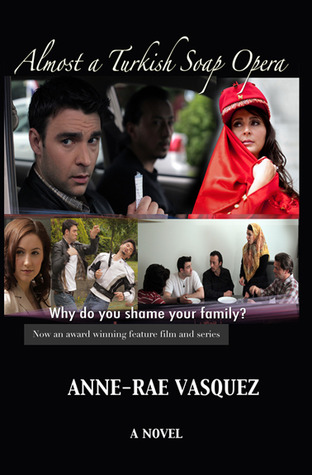
Almost a Turkish Soap Opera by Anne-Rae Vasquez


So, I have had this review in draft form for a couple weeks now, because it was so difficult for me to properly review this book. I didn't want to be overly critical or complementary of something based on my own subjective tastes and interests. I rarely read out of my comfort zone, which is something I've tried working on to expand my horizons and so I could expose myself to different types/genres of writing that I would almost never pick up otherwise. And this story certainly takes me away from my standard literary fare, and deserved a more objective review than I would have written right after I finished reading it. Almost a Turkish Soap Opera is precisely what the title intimates, and while I was very entertained by the plot I was not so much a fan of the layout of the novel. This story was written as a screenplay, and reads just as a television show summary would. Almost a Turkish Soap Opera is a fascinating look into the Turkish culture in today's society, and is worthy of the 4 out of 5 stars I'm giving to it.

From the publisher:
Almost a Turkish Soap Opera is a story about Adel,a young Turkish man whose family has lived in poverty while his grand uncle controls the inheritance money which rightfully belongs to his father. Adel travels to the USA with his best friend Kamil, works illegally, and is deported back to Istanbul. He flies to Canada, marries his rich grand uncle's spoiled obnoxious granddaughter in exchange for his permanent resident status. He becomes infatuated with his beautiful English teacher and tries to hide this from his wife. How did his life turn into a Turkish soap opera?

The novel paints a vivid portrayal of the lives and struggles of young modern Muslim adults trying to make a life in the West. The story will attract audiences of popular contemporary movies such as the Kite Runner and the Brick Lane. A published author, Anne-Rae Vasquez, wrote the novel, Almost a Turkish Soap Opera (to be released in 2012), Gathering Dust, a collection of poems, and Teach Yourself Great Web Design in a Week, published by Sams.net (a division of Macmillan Publishing).

My thoughts:
As I stated above, I was not a fan of the layout. Screenplays are difficult to read because it's essentially just a play by play of what would be happening in the show/movie. There is little in the way of inner dialogue and conflict; most of the writing is devoted to the actions and what the characters are doing. I need inner conflict! I need to hear more of what's going on in Adel's mind, and what he's thinking about throughout his dramatic time in America and Canada. He's got a very interesting inner dialogue, based on what Vasquez did put in her story. I could definitely see this on TV, though, kind of a dramatic Turkish "Days of Our Lives" or something else (I only know that show because my mother used to watch it)  :P

Although I would have preferred to see a 'standard' novel version of this story, the plot and the characters are a lot of fun. The plot is interesting, easy to follow, and fun to read, and offers a lot of insight into the lives of modern Muslim families. Adel and Kamil are likable characters, and I had a good time reading a story where I had to really extrapolate to picture myself in their shoes (particularly since I am not Muslim, and won't really have to worry about having an arranged, loveless marriage). I would definitely feel the same way though, and fight with my family to be able to pave my own way through life, and marry who I choose, rather than who my family decides I should marry.

All in all, while this wasn't something I normally sink my teeth into, I'm glad I did and I definitely recommend it for anyone who regularly watches/reads soap opera types of stories, or who's looking to try something new and exciting. Who knows, you might learn something new, or just find a new genre you enjoy!

- Justin